Pediatric & Congenital Cardiology
Congenitally Corrected Transposition of the Great Arteries(ccTGA): Medical-Legal Considerations and the Double Switch Controversy
- Published
- November 12, 2026
- Last Reviewed
- November 12, 2026
- Author
- Asif Masood, MD, MSc
- Reading Time
- 14 min
- Category
- Pediatric & Congenital Cardiology
This article is for education only. It does not give legal advice or offer an opinion on liability in any specific case.
Introduction
Congenitally corrected transposition of the great arteries (ccTGA, also called L-TGA) is a rare and unusual heart defect. It makes up about 0.5% of all congenital heart defects (Zubrzycki et al., Journal of Clinical Medicine, 2024). Most congenital heart defects need surgery to correct abnormal blood flow. In ccTGA, blood already flows to the right places. The problem is that the wrong pumping chamber does the work for the body. That mismatch may cause no trouble for decades, or it may lead to heart failure, valve leakage, heart block, and sudden death.
ccTGA raises distinct medicolegal questions. When there are no other defects, physicians genuinely disagree about whether to operate at all. Some favor the complex "double switch" operation early in life to prevent problems later. Others favor watching carefully and stepping in only when trouble starts. The medical literature supports both views in selected patients. A bad outcome under either approach does not, by itself, show that the chosen strategy was wrong.
Clinical Vignette (Hypothetical)
The following case is fictional and written only for educational purposes.
A fetal echocardiogram at 22 weeks shows ccTGA with an intact ventricular septum, no outflow obstruction, and a normal-appearing tricuspid valve. Heart rhythm is normal. The baby is born at term, is pink, and passes the newborn pulse oximetry screen. A pediatric cardiologist confirms the diagnosis by echocardiogram and recommends regular monitoring. The parents are told about two options: watchful waiting, or referral to a distant center for pulmonary artery banding followed by a double switch operation.
After a discussion that is only briefly documented, the family chooses observation. At age 6, an echocardiogram shows moderate tricuspid regurgitation (leaking of the valve) and mildly reduced function of the systemic right ventricle. A referral center now judges the left ventricle "deconditioned." Retraining it with a pulmonary artery band is considered higher risk at this age. At age 9, the child develops complete heart block and needs a pacemaker.
The family later asks whether early anatomic repair should have been recommended more strongly, whether the decline was caught in time, and whether informed consent was adequate. A defense review would point out that many children with isolated ccTGA do well for decades without surgery. It would also note that the double switch carries its own serious risks and that heart block often develops regardless of treatment.
Understanding ccTGA
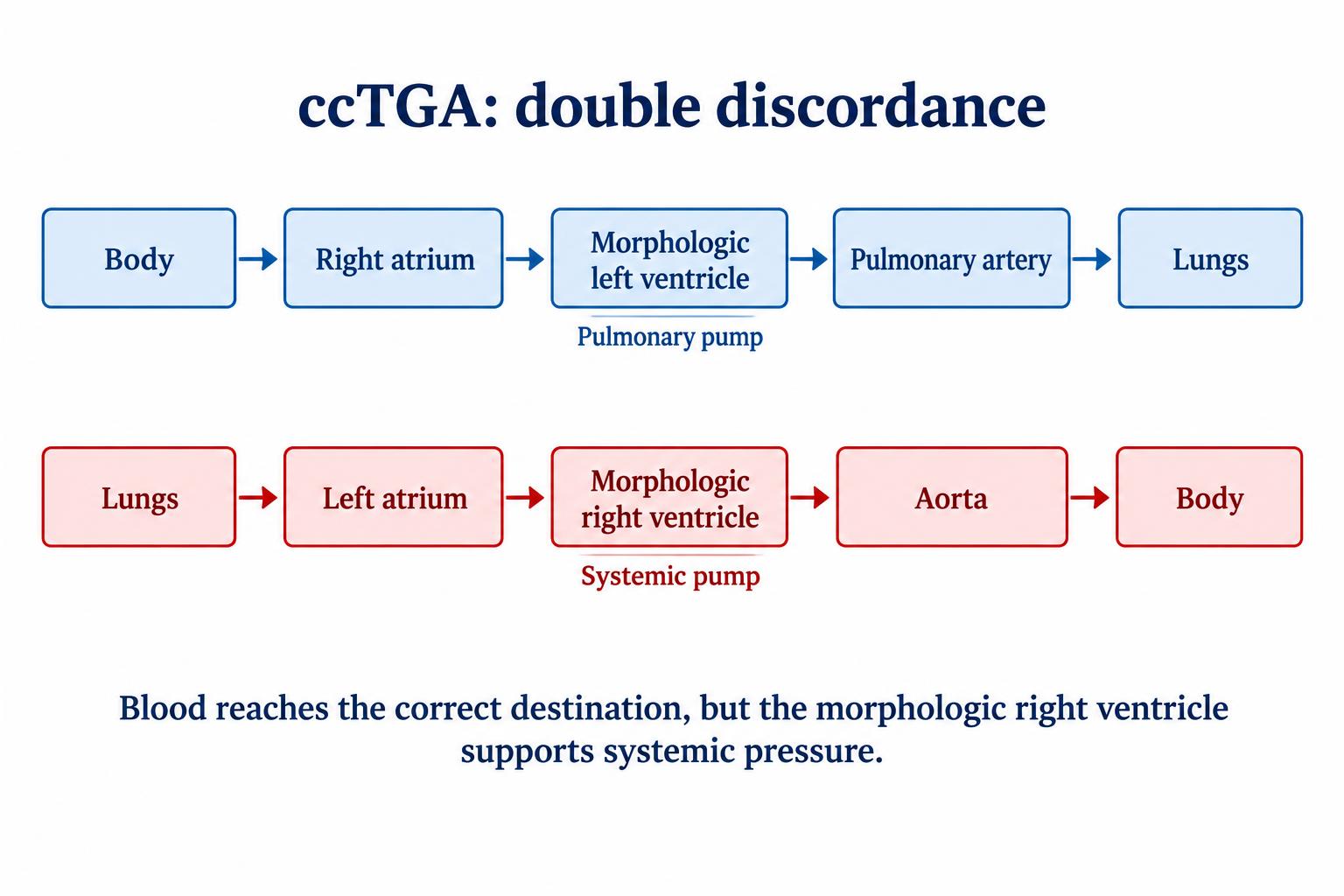
In a normal heart, the right atrium empties into the right ventricle, which pumps blood to the lungs. The left atrium empties into the left ventricle, which pumps blood to the body. In ccTGA there are two "switches," known as double discordance:
- The right atrium connects to the morphologic left ventricle, which pumps to the pulmonary artery.
- The left atrium connects to the morphologic right ventricle, which pumps to the aorta.
Because the two errors cancel out, oxygen-poor blood still goes to the lungs and oxygen-rich blood still goes to the body. The word "corrected" is misleading, however. The heart remains far from normal whatever management strategy is chosen (Silversides and Roche, JACC: Cardiovascular Imaging, 2022). The right ventricle and its tricuspid valve are built to pump against low lung pressures, not the high pressure of the body. Over time the right ventricle may dilate and weaken, and the tricuspid valve may leak. A leaking valve worsens the ventricle, and a weaker ventricle worsens the leak.
The conduction system, which carries electrical signals through the heart, is also abnormally placed and fragile. About 10% of patients have complete heart block at diagnosis. The rest face about a 2% per year risk of developing it (Silversides and Roche, 2022). The lifetime risk may reach 50% by age 50 (Hernández-Madrid et al., Heart Rhythm Society position paper, 2018).
Associated Lesions Matter
Most patients with ccTGA have other defects, such as a ventricular septal defect (VSD), pulmonary stenosis, or an abnormal (Ebstein-like) tricuspid valve (Zubrzycki et al., 2024). These lesions often drive the timing of surgery (Fitzgerald et al., Pediatric Radiology, 2025). Patients without them, described as "isolated" or "uncomplicated" ccTGA, have the most favorable natural history. They are also the group in which the surgical debate is sharpest.
Natural History
Without treatment, the course is often marked by progressive right ventricular failure, tricuspid regurgitation, arrhythmias, and sudden cardiac death. Sudden death has been reported in about half of patients before age 40 (Zubrzycki et al., 2024). That figure includes patients with associated lesions.
The outlook for isolated ccTGA is better. In the classic multicenter study by Graham and colleagues, as summarized by Andrade et al. (Heart Failure Reviews, 2020), about one-third of patients with isolated ccTGA had moderate or severe right ventricular dysfunction by age 45. The figure was more than half for those with associated lesions. Symptomatic heart failure occurred in 25% versus 67%. Patients with isolated ccTGA and minimal tricuspid regurgitation can keep normal ventricular function and stay well for decades (Andrade et al., 2020).
Heart failure and sudden death are the leading causes of death. Associated cardiac anomalies and complete heart block at diagnosis independently predict mortality (Dib et al., JACC: Advances, 2024). In adults, systemic right ventricular function declines measurably over time. Hypertension and left ventricular pacing are among the factors linked to faster decline (Egbe et al., JACC: Cardiovascular Imaging, 2022).
Diagnosis
ccTGA can be found before birth on fetal echocardiography, although the reversed ventricles can be subtle on a routine anatomy scan. After birth, a baby with isolated ccTGA usually looks well, has normal oxygen levels, and may pass pulse oximetry screening. The diagnosis is often made by chance: on an echocardiogram ordered for a murmur, an abnormal ECG, an abnormal chest x-ray, or heart block. Some cases are not found until adulthood, when heart failure or arrhythmia appears.
In a 2026 cohort, conduction disease was present in about half of patients. Complete heart block at diagnosis was more common in prenatally diagnosed cases (15.7% vs 2.0%). About 31% of patients eventually needed a permanent pacemaker (Nield et al., Pediatric Cardiology, 2026). A late diagnosis of isolated ccTGA in an otherwise well child therefore does not automatically mean care fell below standard. The lesion often produces no signs that would prompt testing.
Management Strategies
Surgical strategies fall into four groups (Jacob et al., Journal of the American College of Cardiology, 2024):
- Observation: For isolated ccTGA with good right ventricular and tricuspid function. Includes serial imaging, rhythm monitoring, and blood pressure control.
- Physiologic repair: Fixes associated defects (for example, closing a VSD) but leaves the right ventricle pumping to the body.
- Anatomic repair: Makes the left ventricle the systemic pump again. The double switch operation combines an atrial switch (Senning or Mustard) with an arterial switch. When a VSD and pulmonary stenosis are present, a Rastelli or Nikaidoh-type procedure replaces the arterial switch.
- Single-ventricle (Fontan) palliation: For anatomy unsuitable for two-ventricle repair.
Other options include tricuspid valve surgery, cardiac resynchronization, and, for end-stage failure, ventricular assist devices or heart transplantation (Filippov et al., Circulation, 2016).
The Double Switch Controversy in Isolated ccTGA
This is the central medicolegal issue for patients without associated lesions.
The left ventricle "deconditions." In isolated ccTGA, the left ventricle pumps only against low lung pressures. Over time it loses the muscle mass needed to support the body. Before a double switch, it must be "retrained" with a pulmonary artery band (PAB), a surgical constriction that raises the pressure it pumps against. Retraining usually takes 6–12 months, and standard methods have still produced left ventricular failure rates of about 15% after the double switch (Gusseva et al., Medical Image Analysis, 2025).
Age is critical. In a Boston series, left ventricular dysfunction after anatomic repair developed in 4 of 6 patients banded after age 2. None of the 12 patients banded before age 2 developed it (Myers et al., Annals of Thoracic Surgery, 2013). In a Stanford cohort, no patient banded before age 1 developed left ventricular dysfunction after the double switch. Age at first banding correlated strongly with left ventricular function afterward (Duong et al., Journal of the American Society of Echocardiography, 2024). Patients who "failed" retraining were 4 years or older and showed abnormal hypertrophy (Fitzgerald et al., 2025). This creates a time-sensitive window. The longer a decision is deferred, the less feasible anatomic repair may become.
Arguments for early anatomic repair:
- It removes the long-term burden on the systemic right ventricle and tricuspid valve, which is the main driver of late failure (Filippov et al., 2016).
- A 2024 meta-analysis of about 2,800 patients found better long-term survival and fewer reinterventions at 10 years after anatomic repair than after physiologic repair. The benefit was greatest in patients repaired before age 5 and those who had banding beforehand (Jacob et al., 2024; Karamlou and Robinson, Journal of the American College of Cardiology, 2024).
- Excellent results have been reported at high-volume centers. In the Stanford cohort, survival was 97% and left ventricular function was preserved in 93% at a median of 30 months (Fitzgerald et al., 2025).
Arguments for observation:
- Many patients with isolated ccTGA stay asymptomatic with preserved function into middle age or longer (Andrade et al., 2020).
- The double switch is among the most complex operations in congenital heart surgery. It trades one set of problems for others: neoaortic valve leakage, narrowing of the atrial baffles, arrhythmias, and left ventricular failure (Jacob et al., 2024).
- Surgery itself raises arrhythmia risk. In an international study of 1,131 patients, surgery or intervention was linked to more than three times the risk of atrial arrhythmias and of complete heart block (Sellal et al., European Heart Journal, 2025).
- The meta-analysis comparing anatomic and physiologic repair mostly included patients with associated lesions. It does not directly compare double switch with observation in isolated ccTGA. Its authors warn that the two strategies are hard to compare with observational data. They also note that results may reflect experienced, high-volume centers, and that physiologic management can do well when right ventricular and tricuspid function are preserved (Jacob et al., 2024).
- "Prophylactic" banding in isolated ccTGA is described as controversial. Optimal timing and patient selection remain unresolved (Fitzgerald et al., 2025).
Where consensus exists. There is broad agreement on several points. Patients with impaired right ventricular function or moderate or worse tricuspid regurgitation do poorly with physiologic management, and anatomic repair has better outcomes in that group, especially in young patients with adequate left ventricular training (Jacob et al., 2024). Center experience matters. Decline should be recognized early, while anatomic repair is still an option.
No randomized trial has compared prophylactic double switch with observation in isolated ccTGA. None is likely, given how rare the lesion is. Either strategy may be medically reasonable, and an expert should judge the choice by the process that led to it rather than the outcome alone.
Medical Considerations in Evaluating Standards of Care
The legal standard of care is set by each jurisdiction and decided by the trier of fact. The medical issues commonly examined in expert review include:
- Informed consent and shared decision-making: Were both observation and anatomic repair, with their risks, benefits, and time-sensitive nature, explained? Was referral to a center experienced in the double switch offered or discussed? Given genuine professional disagreement, the quality of this discussion is often more central than which option was chosen.
- Surveillance: Were echocardiograms, rhythm monitoring (ECG, Holter), and, when appropriate, cardiac MRI done at intervals suited to the patient's age and findings?
- Recognizing decline: Were worsening tricuspid regurgitation, falling right ventricular function, or new conduction disease recognized and acted on? Tricuspid regurgitation usually comes before clinical heart failure (Andrade et al., 2020).
- Timely referral: When decline appeared, was the patient referred while left ventricular retraining was still feasible?
- Conduction disease: Was heart block anticipated, families counseled about symptoms, and pacing provided when indicated? Because left ventricular pacing is linked to faster right ventricular decline (Egbe et al., 2022), pacing strategy may also be reviewed.
- Operative and perioperative care: If surgery was performed, the issues are patient selection, readiness criteria for the double switch (left ventricular pressure and function), surgical technique, and recognition of complications such as baffle obstruction or surgical heart block.
- Adult transition: Was care transferred to an adult congenital heart disease program? Was blood pressure controlled?
Common Allegations in Litigation
- Failure to offer or refer for anatomic repair in infancy, with later loss of the retraining window. Defense themes: observation is a recognized strategy, and the evidence favoring prophylactic repair in isolated ccTGA is limited.
- Inadequate informed consent: missing discussion of alternatives, time sensitivity, or center experience.
- Delayed recognition of right ventricular decline or tricuspid regurgitation during surveillance.
- Delayed diagnosis of ccTGA: often hard to sustain in isolated cases, which usually cause no symptoms.
- Complications after the double switch: left ventricular failure, neoaortic regurgitation, baffle obstruction, or heart block. Defense themes: known risks of a complex operation.
- Missed or delayed management of heart block, including syncope or sudden death.
- Documentation deficiencies: particularly about consent discussions and the rationale for the chosen strategy.
Medical Causation
Causation in ccTGA is especially complex for several reasons.
- The natural history varies widely. Some patients never decline; others decline in childhood. Experts must estimate what this patient's course would probably have been under the alternative strategy.
- The alternative carries its own risks. Showing that an earlier double switch would have avoided right ventricular failure requires weighing the operation's own mortality, left ventricular failure (about 15% in some series), reintervention, and arrhythmia risks.
- Heart block often develops whatever is done. It occurs spontaneously at about 2% per year, though surgery raises the risk (Silversides and Roche, 2022; Sellal et al., 2025).
- Center effects: Published double switch outcomes come mostly from high-volume centers and may not apply to every hospital.
- Probability versus possibility: Most jurisdictions require that a different outcome be "more likely than not." Given the evidence gaps described above, experts may reasonably disagree on whether that threshold is met.
Long-Term Outcomes
After anatomic repair, single-center series report 10-year survival of 80% to 90% with good functional outcomes. Complications include aortic regurgitation, baffle stenosis, and arrhythmias (Jacob et al., 2024). In the meta-analysis, 5-year mortality was about 10% after anatomic repair and about 11% after physiologic repair. The differences widened over longer follow-up (Karamlou and Robinson, 2024). These pooled figures mostly reflect patients with associated lesions.
Arrhythmias are common under any strategy. Cumulative rates of atrial or ventricular arrhythmia or complete heart block reached 44.5% at 10 years and 58.8% at 20 years (Sellal et al., 2025). Lifelong care at an experienced congenital heart program is needed for everyone. For adults with end-stage systemic right ventricular failure, heart transplantation remains the definitive option (Filippov et al., 2016).
Medical Records That Often Matter
- Fetal echocardiography reports and prenatal counseling notes
- Cardiology clinic notes, with particular attention to documented consent discussions and the reasons for choosing observation or surgery
- Serial echocardiogram reports and images, including tricuspid regurgitation grade and right ventricular function over time
- Cardiac MRI and catheterization data, especially left ventricular pressure ratios and ejection fraction before a double switch
- ECGs, Holter monitors, and pacemaker records
- Referral correspondence with surgical centers
- Operative reports, perfusion records, and ICU records
- Adult congenital transition records and blood pressure history
Common Misconceptions
- "Corrected" means the heart is fixed. It does not. Blood flow is routed correctly, but the systemic right ventricle and conduction system are vulnerable for life.
- Isolated ccTGA always needs surgery. Many patients do well for decades with observation alone. Whether to operate prophylactically is still debated.
- The double switch cures the condition. It replaces right ventricular risk with other risks and requires lifelong follow-up.
- Heart block means something was done wrong. Spontaneous heart block is part of the natural history.
- Meta-analyses settle the question. The available comparisons are observational, are dominated by patients with associated lesions, and come mostly from expert centers.
The Value of Pediatric Cardiology Expertise
Evaluating a ccTGA case requires expertise in congenital cardiac anatomy and physiology, serial imaging of the systemic right ventricle, conduction disease, criteria for left ventricular retraining, and the surgical outcome literature. An expert must be able to explain an open clinical controversy fairly. That means recognizing when a choice between reasonable strategies was made appropriately, and when surveillance, referral, or consent fell short.
Key Takeaways for Attorneys
- ccTGA is rare, and "corrected" is a misnomer. The right ventricle supports the body for life unless anatomic repair is performed.
- Isolated ccTGA often causes no symptoms and may be diagnosed late without any error in care.
- Major long-term risks are systemic right ventricular failure, tricuspid regurgitation, complete heart block (about 2% per year), and sudden death.
- Patients with isolated ccTGA have a substantially better natural history than those with associated defects.
- Whether to perform a prophylactic double switch in isolated ccTGA is an unresolved controversy, with no randomized evidence.
- The double switch requires retraining the left ventricle with a pulmonary artery band. Results are best when banding starts early, ideally before age 1–2.
- Anatomic repair carries its own serious risks and has the best results at high-volume centers.
- In disputes about strategy, the key issues are often informed consent, surveillance, and timely referral, not the strategy itself.
- Causation analysis must weigh the patient's likely natural course against the risks of the alternative operation.
- An objective review by an expert in pediatric and congenital cardiology is essential.
References
- Zubrzycki et al., Journal of Clinical Medicine, 2024.
- Silversides and Roche, JACC: Cardiovascular Imaging, 2022.
- Hernández-Madrid et al., Heart Rhythm Society position paper, 2018.
- Fitzgerald et al., Pediatric Radiology, 2025.
- Andrade et al., Heart Failure Reviews, 2020.
- Dib et al., JACC: Advances, 2024.
- Egbe et al., JACC: Cardiovascular Imaging, 2022.
- Nield et al., Pediatric Cardiology, 2026.
- Jacob et al., Journal of the American College of Cardiology, 2024.
- Filippov et al., Circulation, 2016.
- Gusseva et al., Medical Image Analysis, 2025.
- Myers et al., Annals of Thoracic Surgery, 2013.
- Duong et al., Journal of the American Society of Echocardiography, 2024.
- Karamlou and Robinson, Journal of the American College of Cardiology, 2024.
- Sellal et al., European Heart Journal, 2025.
Educational Disclaimer
This article is provided for educational purposes only and does not constitute legal or medical advice. Every case is unique and should be evaluated on its individual facts and medical records. Reading this article does not create an expert-client relationship.
About the Author
Asif Masood, MD, MSc is double board-certified in General Pediatrics and Pediatric Cardiology. Expert witness services in general pediatrics and pediatric & congenital cardiology, complemented by independent, non-testimony medical consulting across a broad range of medical specialties. Through The Verdict MD, he serves attorneys, law firms, insurers, and healthcare organizations nationwide.
Learn about Dr. Masood's pediatric cardiology expert witness services for independent review of the medical questions in your case.