
General Pediatrics
Decoding Pediatric Pulmonary Function Testing: A Guide for Attorneys
- Published
- November 1, 2026
- Last Reviewed
- November 1, 2026
- Author
- Asif Masood, MD, MSc
- Reading Time
- 7 min
- Category
- General Pediatrics
Pulmonary function tests (PFTs) are often part of the record in pediatric cases involving asthma, environmental or toxic exposure, prematurity, neuromuscular disease, sports or school clearance, and personal injury claims involving the lungs. A PFT report looks objective: it contains numbers, percentages, and graphs. But how it is read depends on the child's age, cooperation, test quality, and which reference values were used. This article explains how to read a pediatric PFT report and where disputes usually come from.
Clinical Vignette (Hypothetical)
A 9-year-old with a history of wheezing has spirometry in a primary care office. The report shows an FEV1 of 78% of predicted, and the child is labeled as having "abnormal lung function." Two years later, after an alleged environmental exposure, a second test is reported as "declined." On review, the first test has no notes on effort quality, the two tests used different reference equations, and the child grew 12 cm in between. Was there a real change in lung function, or is the "decline" an artifact of how the tests were done and interpreted?
This scenario shows a central point: a PFT number means little until test quality, reference values, and the child's growth are checked.
What Is Pulmonary Function Testing?
"PFT" is a broad term for a group of breathing tests. They include spirometry, lung volume measurement, diffusing capacity, peak flow, methacholine challenge, oscillometry, exercise testing, and exhaled nitric oxide (FeNO) (de Waal Malefyt et al., Pediatrics in Review, 2026).
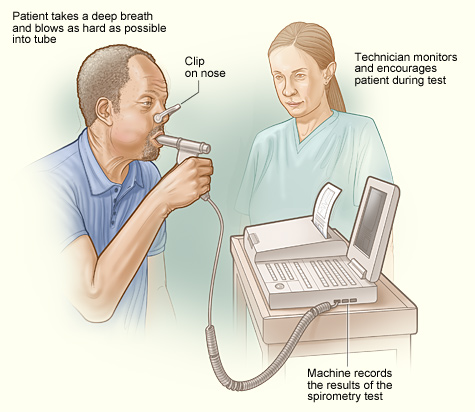
- Spirometry is the most common test, done in both primary care and specialty clinics. The child takes the deepest possible breath and blows out as hard and as long as possible.
- Lung volumes, diffusing capacity, and challenge testing are usually done in specialty pulmonary labs.
The Key Numbers on a Spirometry Report
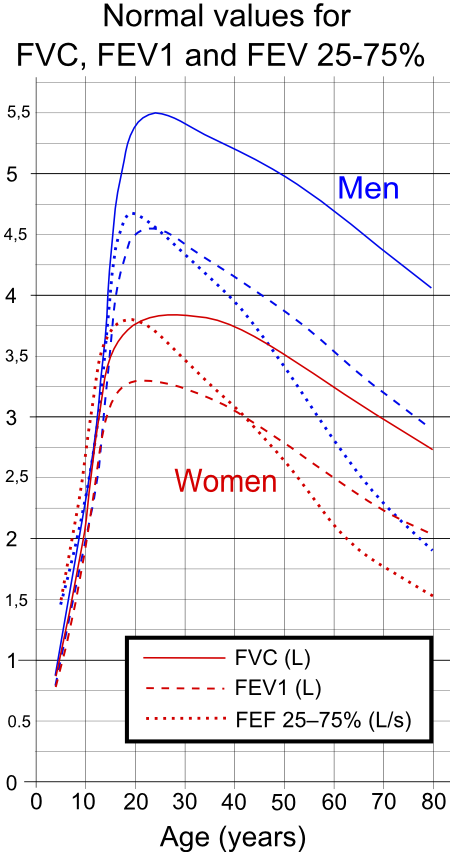
- FVC (forced vital capacity): the total amount of air blown out after a full breath in.
- FEV1 (forced expiratory volume in 1 second): how much air comes out in the first second.
- FEV1/FVC ratio: the share of air exhaled in the first second. A low ratio means obstruction (narrowed airways, as in asthma).
- FEF25–75: flow in the middle part of the breath. It is sometimes used as a sign of small-airway problems, but it varies a lot.
- Flow-volume loop: a graph of the breath. Its shape can point to obstruction (a "scooped-out" curve), restriction (a small curve that keeps its normal shape), an upper airway blockage, or poor effort (Heckman and O'Connor, JAMA, 2015; Marpole et al., Pediatric Anesthesia, 2022).
The Four Basic Patterns
Normal
- What it means
- All values within the expected range
- Typical pediatric examples
- —
Obstructive
- What it means
- Low FEV1/FVC ratio
- Typical pediatric examples
- Asthma, cystic fibrosis, bronchopulmonary dysplasia
Restrictive (suspected)
- What it means
- Low FVC with a normal ratio; must be confirmed by measuring lung volumes
- Typical pediatric examples
- Neuromuscular weakness, chest wall deformity, interstitial disease, obesity
Mixed
- What it means
- Both low ratio and low FVC
- Typical pediatric examples
- Complex chronic lung disease
| Pattern | What it means | Typical pediatric examples |
|---|---|---|
| Normal | All values within the expected range | — |
| Obstructive | Low FEV1/FVC ratio | Asthma, cystic fibrosis, bronchopulmonary dysplasia |
| Restrictive (suspected) | Low FVC with a normal ratio; must be confirmed by measuring lung volumes | Neuromuscular weakness, chest wall deformity, interstitial disease, obesity |
| Mixed | Both low ratio and low FVC | Complex chronic lung disease |
Spirometry alone cannot confirm restriction. A low FVC only raises the question, and total lung capacity has to be measured to answer it (Heckman and O'Connor, JAMA, 2015).
Bronchodilator Response
Spirometry is often repeated after an inhaled bronchodilator such as albuterol. Improvement supports asthma, but no improvement does not rule asthma out (Heckman and O'Connor, JAMA, 2015). Asthma in children is a clinical diagnosis, and testing is used to support it, not replace it (de Waal Malefyt et al., Pediatrics in Review, 2026).
The Most Important Concept: "Percent Predicted" Versus Z-Scores
Older reports, and many office reports, call a value abnormal if it is below 80% of predicted. Current international standards have moved away from that cutoff.
- The 2022 European Respiratory Society/American Thoracic Society (ERS/ATS) technical standard strongly discourages the 80% cutoff. It defines abnormal as below the 5th percentile of healthy children, a z-score below −1.645 (Stanojevic et al., ERS/ATS, 2022; Ben Saad, Pediatric Pulmonology, 2023).
- The fixed 80% cutoff has led to systematic misreading of results, particularly in children (Ben Saad, Pediatric Pulmonology, 2023).
- Severity is graded by FEV1 z-score: mild −1.645 to −2.5, moderate −2.5 to −4.0, and severe below −4.0 (Moffett et al., JAMA Network Open, 2023).
Why this matters in litigation: a child labeled "abnormal" at 78% predicted may be normal by current z-score standards, and the reverse can also happen.
Reference Equations: Which "Normal" Was Used?
Predicted values come from equations based on age, sex, and height. The ERS/ATS recommends the Global Lung Function Initiative (GLI) equations (Stanojevic et al., ERS/ATS, 2022).
- In 2023, GLI moved to race-neutral equations. This changed how some children's results are classified (Forno et al., JAMA Pediatrics, 2024; Moffett et al., JAMA Network Open, 2023).
- Predicted values differ between GLI versions, especially in adolescents (Graham et al., Chest, 2025). GLI may overestimate expected lung size in some adolescent groups, which can lead to an incorrect diagnosis of lung disease (Hüls et al., PLoS One, 2016).
Practical point: when comparing a child's tests over time, confirm that the same reference equation was used. A change of equation can create an apparent improvement or decline even if the lungs did not change.
Why Children Are Different
- Effort and cooperation: spirometry depends on effort. Some 5-year-olds can do it, and most 10-year-olds can produce acceptable results (Marpole et al., Pediatric Anesthesia, 2022).
- Greater variability: children's results vary more than adults', both because of chest wall physiology and because of cognitive development (Stanojevic et al., ERS/ATS, 2022).
- Growth spurts: during puberty, height and lung growth do not always keep pace. Serial results need special care so that a normal plateau is not mistaken for decline (Stanojevic et al., ERS/ATS, 2022).
- Preschool children: other tests, such as oscillometry and plethysmography, may be used, and they have their own thresholds (Chawes and Elenius, Current Opinion in Allergy and Clinical Immunology, 2022).
Test Quality: The First Question in Any Review
The ERS/ATS states that poorer-quality tests must be interpreted with greater uncertainty. They may not reflect true lung impairment (Stanojevic et al., ERS/ATS, 2022). A proper interpretation first checks acceptability and repeatability and reviews the technician's comments, and only then classifies the pattern (Marpole et al., Pediatric Anesthesia, 2022). Testing should be done by staff with pediatric experience.
Common Litigation Targets
- Diagnosing or ruling out asthma on spirometry alone, without the clinical picture
- Failure to order testing, or to refer, when symptoms persist
- Labeling restriction from spirometry without lung volume confirmation
- Using the outdated 80% cutoff
- Claiming "decline" between tests that used different equations, different labs, or poor-quality efforts
- Attributing abnormal results to an exposure or injury without accounting for asthma, prematurity, obesity, or neuromuscular disease
- Missing upper airway obstruction that was visible on the flow-volume loop
Common Defense Considerations
- Asthma is a clinical diagnosis, and normal spirometry between flares is common
- A lack of bronchodilator response does not exclude asthma
- Test-to-test variability in children is substantial
- Results may have been read correctly under the standards in use at the time; the 2022 ERS/ATS changes and the 2023 GLI changes are recent
- Pre-existing conditions may explain the abnormal results
Records That Matter
- The full PFT report, including raw flow-volume curves, not just the summary
- Technician comments on effort, acceptability, and repeatability
- The reference equation and its version
- Height, age, and sex entered at the time of testing
- Bronchodilator use and the timing of medications before the test
- All prior and later tests, for trend analysis
- Clinical notes describing symptoms, examination findings, and treatment response
Key Takeaways for Attorneys
- A PFT number is only as reliable as the quality of the test behind it.
- Current standards use z-scores and the 5th percentile, not "80% of predicted."
- Spirometry suggests restriction but cannot confirm it.
- A normal test, or no response to a bronchodilator, does not exclude asthma.
- Serial tests are comparable only with the same reference equations and attention to growth.
- The 2023 race-neutral GLI equations may change how some results are classified.
- Raw curves and technician notes are often more revealing than the summary page.
- Pediatric interpretation needs pediatric expertise.
References
- de Waal Malefyt et al., Pediatrics in Review, 2026.
- Heckman and O'Connor, JAMA, 2015.
- Marpole et al., Pediatric Anesthesia, 2022.
- Stanojevic et al., ERS/ATS technical standard, 2022.
- Ben Saad, Pediatric Pulmonology, 2023.
- Moffett et al., JAMA Network Open, 2023.
- Forno et al., JAMA Pediatrics, 2024.
- Graham et al., Chest, 2025.
- Hüls et al., PLoS One, 2016.
- Chawes and Elenius, Current Opinion in Allergy and Clinical Immunology, 2022.
Educational Disclaimer
This article is provided for educational purposes only and does not constitute legal or medical advice. Every case is unique and should be evaluated on its individual facts and medical records. Reading this article does not create an expert-client relationship.
About the Author
Asif Masood, MD, MSc is double board-certified in General Pediatrics and Pediatric Cardiology. Through The Verdict MD, he provides expert witness services in pediatric and congenital cardiology and general pediatrics, as well as independent medical consulting for attorneys, law firms, insurers, and healthcare organizations nationwide.